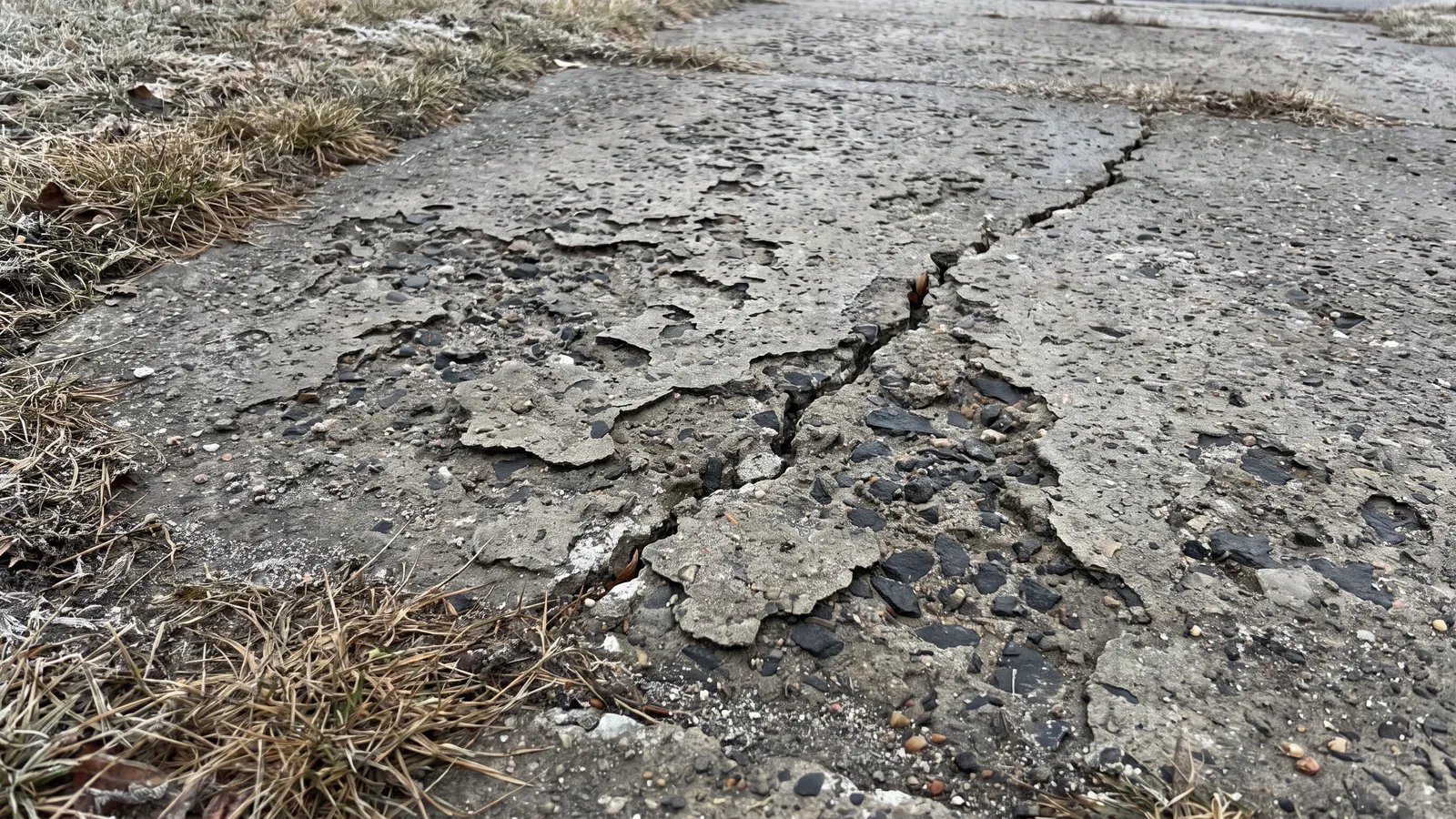
Concrete shrinks as it cures and keeps moving with temperature and moisture for the rest of its life, so cracks are a certainty; the joints cut into a slab are there to decide where they happen. A crack becomes a problem when it lets water into the base, when one side drops or lifts, or when it's a symptom of something under the slab. Here is the sorting.
Reading the crack
| What you see | Likely cause | What to do |
|---|---|---|
| Hairline, random, both sides level, often in a web | Plastic shrinkage or crazing from fast drying | Cosmetic. Seal the slab; nothing else |
| Straight crack between two joints, level | Shrinkage where a joint should have been | Route and seal with a flexible sealant |
| Crack with a step across it, one side low | Base washed out or settled under one side | Lift the low side (foam) or replace the panel; fix the water |
| Crack with one side high, often near a tree | Root or frost heave | Grind a small lip; replace the panel for more; address the root |
| Crack at a corner, triangle broken off | Point load or no thickened edge | Patch with repair mortar keyed in; prevent the load |
| Flaking around a crack, pitting, exposed stone | Freeze-thaw spalling, no air in the mix | Light: grind and overlay. Widespread: replace |
| Crack following a line where two pours meet | Cold joint with no isolation | Route and seal; it will move, so use a flexible product |
| Wide, growing, with heaving sections (a basement or garage floor) | Water under the slab, expansive fill, or a failed drain | Find the cause first; then level or replace |
Fixes you can do
A hairline or narrow crack with both sides level on a driveway, patio or garage floor: clean it out, let it dry, and fill it with a polyurethane or silicone concrete crack sealant from a caulk tube, tooled flush. The job is to keep water out of the crack so it doesn't freeze and widen. Rigid fillers and cement patches in a moving crack fail by spring; use something flexible. Seal the whole slab afterward.
Fixes that need a contractor
- Routing and sealing a longer crack: a saw opens the crack into a clean groove, backer rod goes in, and a flexible sealant tops it. Lasts years.
- Epoxy injection for a structural crack in a wall or a slab that needs to be one piece again. Rare on flatwork.
- Lifting a stepped crack where one side dropped. The leveling page.
- Panel replacement where the crack has broken the slab into pieces, or spalling has started along it.
- Patching broken corners and edges with a polymer-modified repair mortar, cut back to sound concrete and keyed in.
The cause, not just the crack
A crack that keeps coming back after repair is telling you about the base. A downspout emptying beside the slab, a trench that was backfilled loose, a tree root, frost getting under an edge that wasn't thickened. The estimator looks for those first; a repair that treats the crack alone is a yearly appointment.
Cost
Published 2026 figures put concrete repair at $3 to $8 per square foot and slab replacement at $6 to $15 (HomeGuide, Feb 2026). A tube of sealant and an afternoon is the cheapest fix on this site; the repair page has the rest.
Questions
Is a crack in a new driveway normal?
A hairline shrinkage crack in the first year, with both sides level, is common and cosmetic, especially if the joints were cut late. A stepped crack or a wide one in a new slab is not normal; call the contractor who poured it.
What's the best crack filler?
For an exterior slab, a flexible polyurethane or silicone concrete sealant in a caulk tube, applied to a clean dry crack. Rigid cement patches crack again.
Can a crack be made invisible?
Not on exposed concrete. A sealed crack is a neat line; an overlay over the whole slab hides it until the slab moves again.
Should I worry about cracks in my garage floor?
Hairline and level: no. Heaving sections, a wide crack that's growing, or water coming through: yes, because that's the base or a drain.
How do you fix a crack that goes through a stamped patio?
The same way, with a sealant tinted to the color, tooled into the pattern line if the crack follows one. If it doesn't, it'll show; that's the honest answer.
Does sealing the slab stop cracks?
It keeps water out of the surface and the cracks that exist, which slows freeze-thaw damage. It doesn't stop the slab from moving.
Get a written price
Tell us the job and where it is. Someone calls back the same day, an estimator measures it in person, and you get a written price with the thickness, the base and the finish spelled out. Nothing is poured on a verbal.