How thick should a concrete driveway be? Four, five or seven inches, depending on where you're standing
The thickness of a driveway depends on what drives on it and whose land it's on. Here are the numbers, and the base and steel that go with them.
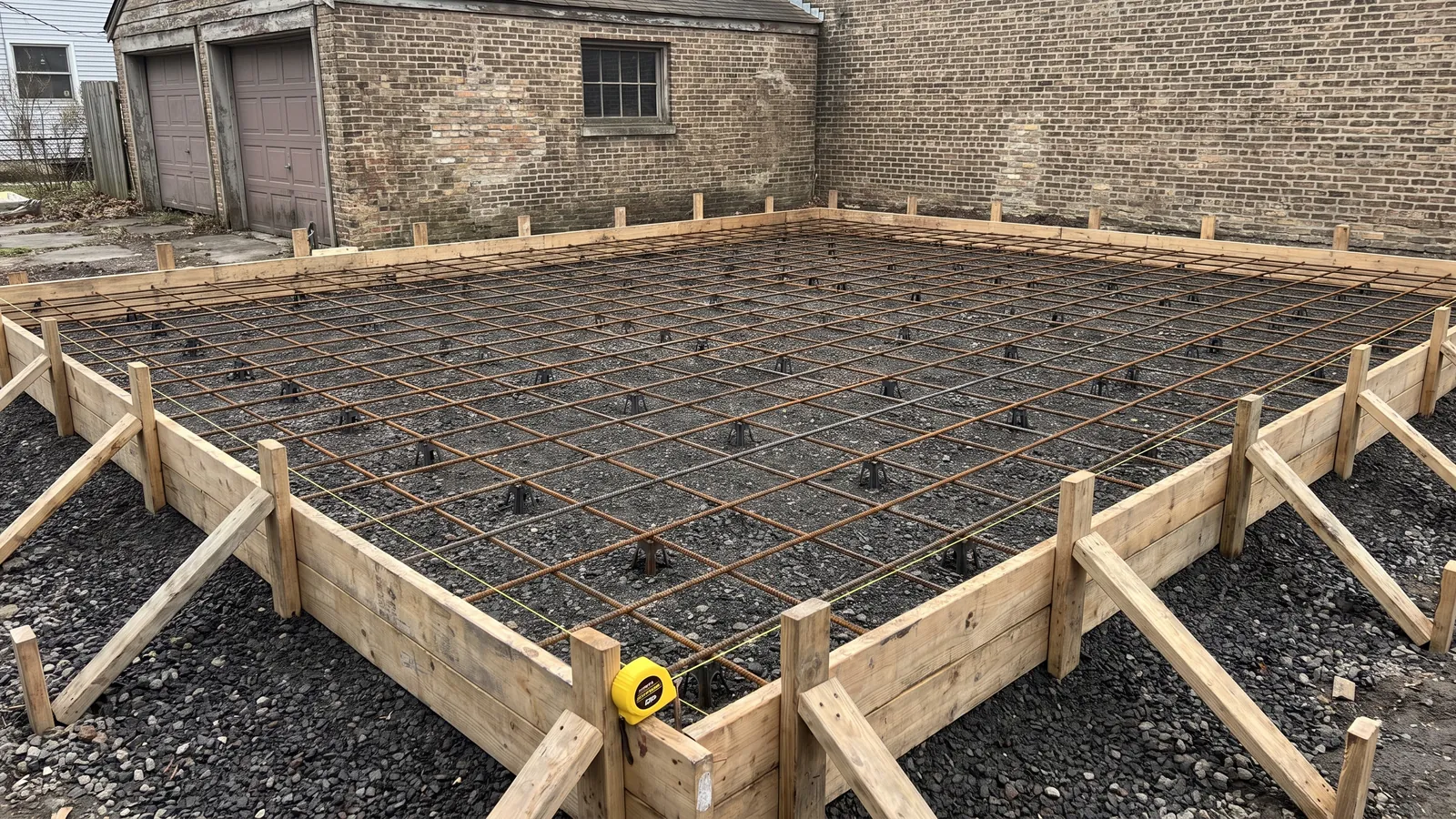
Ask a concrete contractor how thick a driveway should be and the answer is "four inches." That's right for most of a residential driveway and wrong for two parts of it. Here is the whole answer, with the reasons.
Four inches: the residential standard
A 4-inch slab on a compacted gravel base carries cars, SUVs and light trucks indefinitely. It's the published baseline, the cheapest adequate thickness, and what most of the driveways in Cincinnati's suburbs are. It needs reinforcement (fiber, mesh or rebar), control joints every 8 to 10 feet, and an air-entrained mix.
Five inches: trucks, trailers, RVs
A heavy pickup, a boat trailer, an RV or a regular delivery truck wants 5 inches with rebar rather than mesh. The extra inch adds about a quarter to the concrete cost and a lot to the slab's capacity, because strength goes up faster than thickness. If a dumpster will ever sit on the driveway, this is the section to have.
Seven inches: the Cincinnati apron
From the sidewalk to the curb, the City of Cincinnati requires a minimum of 7 inches in an ODOT Class QC1, 4,000 psi, air-entrained mix. The apron takes the plows, the turning traffic and the worst of the salt and water, and it's City property built under a permit by a licensed street contractor. The apron page covers it.
What goes with the thickness
- Base. Four to six inches of compacted gravel. Thickness in the slab doesn't make up for a soft base; a 6-inch slab on mud cracks.
- Reinforcement. Fiber in the mix for crack control on a 4-inch slab; wire mesh on chairs; rebar grid for 5 inches and up. Mesh or rebar lying on the ground does nothing; it has to be in the middle of the slab.
- Joints. Cut to a quarter of the slab's depth (1 inch for a 4-inch slab) at a spacing of about two to three times the thickness in feet (8 to 12 feet for 4 inches), the same day as the pour.
- Thickened edges. Where the driveway meets the garage apron or a step, an extra couple of inches at the edge prevents breaking.
- Strength. 4,000 psi is a sound exterior mix for this climate; 3,500 is common; the apron spec is 4,000.
What's under the old driveway
Driveways from the mid-twentieth century are often 4 inches of unreinforced concrete on little or no base, and sometimes 3. They lasted because cars were lighter and nobody parked a dually on them. When one is replaced, the base is the part that gets fixed first.
Questions
Is 3 inches ever enough?
For a garden path, maybe. For anything a car drives on, no.
Does thicker concrete crack less?
It carries more load before cracking. Shrinkage cracks happen at any thickness; joints control those, not inches.
Should I ask for 5 inches to be safe?
If a truck, trailer or RV will park there, yes. For cars, 4 inches reinforced on a good base is the right spend, and the money is better put into the base and the mix.
Why does the apron have to be so thick?
Because the City says so, and because it takes the plows and the turning traffic. Seven inches of 4,000 psi concrete survives; four doesn't.
How do I know what thickness I got?
Watch the forms before the pour, or ask for the mix ticket and the yardage: a 4-inch slab takes a yard per 81 square feet. The yardage calculator on this site does the math.
Does the garage floor have to match the driveway thickness?
No; the garage floor is its own slab, 4 to 6 inches by what parks inside, with an isolation joint where it meets the driveway.
Get a written price
Tell us the job and where it is. Someone calls back the same day, an estimator measures it in person, and you get a written price with the thickness, the base and the finish spelled out. Nothing is poured on a verbal.