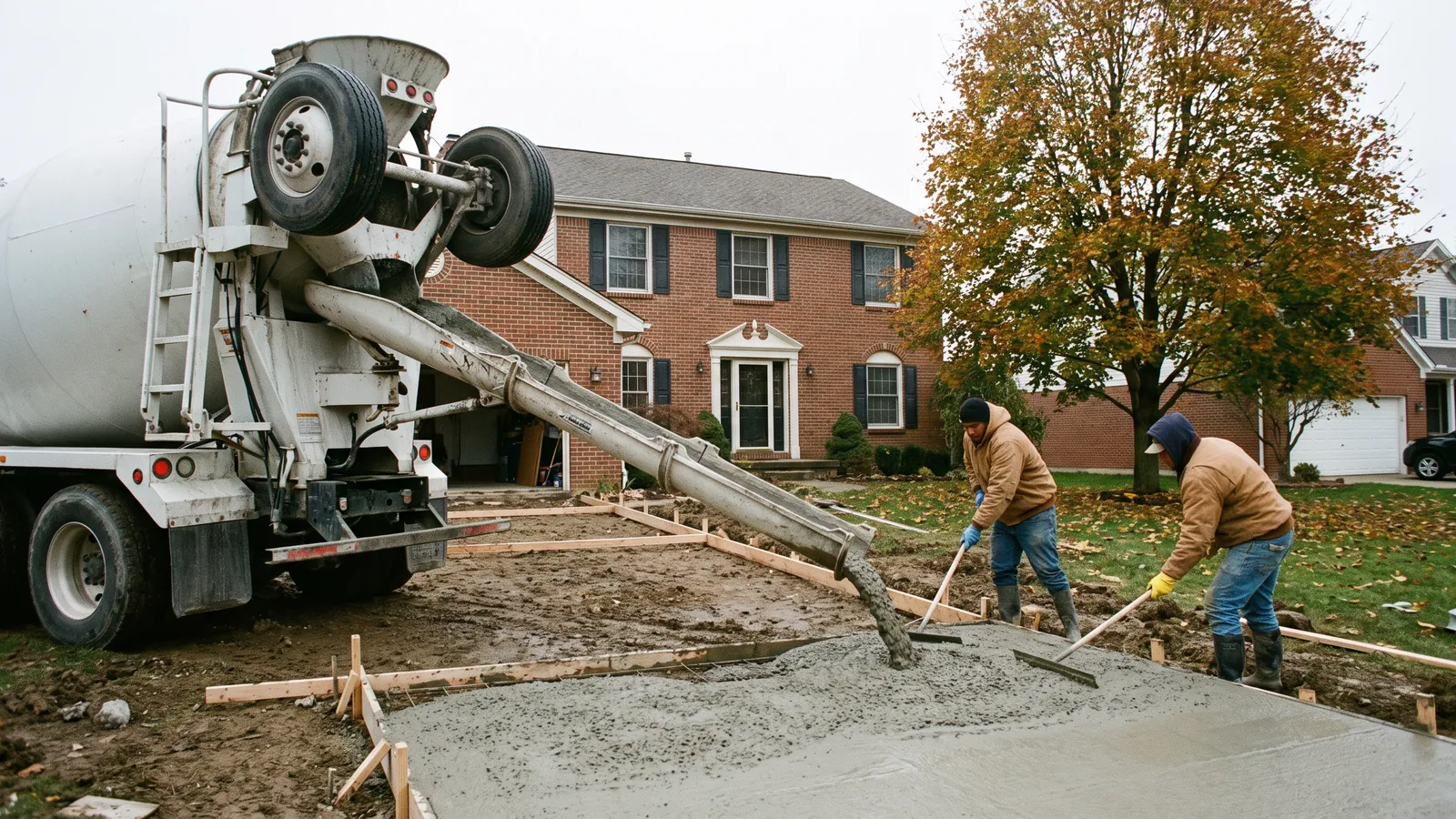
A concrete driveway in this city is a slab 4 inches thick on your lot, 7 inches thick in the City's strip at the street, poured on a base that drains, with air in the mix so the salt doesn't eat it and joints cut so the cracks go where they're told. Done that way it outlasts asphalt by decades. Done cheaply it spalls the second winter. This page is the honest version of what's involved, including the apron, which is where most Cincinnati driveway bids quietly fall short.
New driveway or replacement
New: the ground is excavated to depth, a gravel base is placed and compacted, forms are set to the grade, reinforcement goes in, the concrete is placed, finished and jointed, and the whole thing cures under cover for a week.
Replacement: all of the above after the old driveway is broken out and hauled away. Old asphalt comes up easily; old concrete, especially an unreinforced 1950s slab, comes up in pieces and costs more to remove. We don't pour over an old driveway; a new slab on a cracked one cracks along the same lines.
Widening: a strip added alongside, doweled into the existing slab so the two don't settle apart, with the base matched to the old one.
What's in a driveway that lasts here
- Base. Four to six inches of compacted gravel on undisturbed or compacted ground. Cincinnati's clay holds water and heaves when it freezes; the base drains it away. On a hillside lot the base also has to hold the slope.
- Thickness. Four inches for cars, five where a truck, a trailer or an RV parks. Seven in the right-of-way, because the City says so. The thickness guide goes through it.
- Air entrainment. Microscopic air bubbles in the mix that give freezing water somewhere to expand. The single most important ingredient for a surface that sees road salt. It's on our mix ticket, and you can ask to see it.
- Reinforcement. Wire mesh or rebar on chairs so it sits in the middle of the slab, not on the ground. Fiber in the mix for a 4-inch residential slab is common; rebar for anything heavier.
- Joints. Control joints cut the same day at intervals of about 8 to 10 feet, a quarter of the slab's depth, so shrinkage cracks happen in the joint instead of across the surface. Isolation joints where the slab meets the garage floor, the house and the sidewalk.
- Finish. Broom finish for traction in the wet and the snow; exposed aggregate or stamped if you want a look, with the cost difference on the price.
- Slope. Enough fall to drain, away from the garage and the house, with a drain where a driveway runs downhill toward a garage, which is common on the hillsides.
- Cure and seal. Kept damp or under a curing compound for the first week, no traffic for seven days, sealed after about a month, and no salt the first winter.
The apron
Between the sidewalk and the curb the driveway is on City property, and the City's Department of Transportation and Engineering treats it as street work: a Street Opening Permit, a DOTE-licensed street contractor, a zoning check, Ohio811 marks, and a slab 7 inches thick in an ODOT Class QC1 air-entrained 4,000 psi mix. The curb opening is limited to 15 to 30 feet for a house and can't sit within 50 feet of an intersection. Our price shows the apron as its own line, done under the permit by a licensed street contractor. The apron page and the permit guide have the detail.
What it costs
Published 2026 figures: plain concrete $6 to $10 per square foot installed, exposed aggregate $10 to $15, stamped $15 to $20, a typical two-car driveway $2,400 to $8,600, and removal of the old driveway $2 to $6 per square foot (HomeGuide). Our price is per job, on the driveway cost page in detail.
Questions about this work
How long before I can drive on a new driveway?
Seven days for cars, and we'd rather you wait ten. Concrete reaches most of its strength in a month; the first week is when a tire can leave a permanent mark.
Concrete or asphalt?
Asphalt is cheaper up front and softer in the heat; concrete costs more and lasts two to three times as long with less maintenance. On a hillside, concrete holds its shape better. Both need the City apron done right.
Why did my old driveway flake?
Almost always a mix without air entrainment, salted. Water freezes in the surface, has nowhere to expand, and pops the top layer off. The repair page covers what can be done with a spalled slab; often a new one is the honest answer.
Do you pull the permit for the apron?
Yes. The Street Opening Permit, the zoning check and the Ohio811 marks are handled as part of the job, and the apron is done by a DOTE-licensed street contractor.
Can you widen a driveway without replacing it?
Yes, if the existing slab is sound. The new strip is doweled into the old edge so they move together. A widening next to a cracked, heaving slab is money better put toward replacement.
Does the driveway need a building permit on my lot?
Inside Cincinnati, the apron needs DOTE's permit; the part on your lot generally doesn't need a building permit, though zoning rules on width and setback apply. Suburbs differ, and we check with each building department.
Get a written price
Tell us the job and where it is. Someone calls back the same day, an estimator measures it in person, and you get a written price with the thickness, the base and the finish spelled out. Nothing is poured on a verbal.