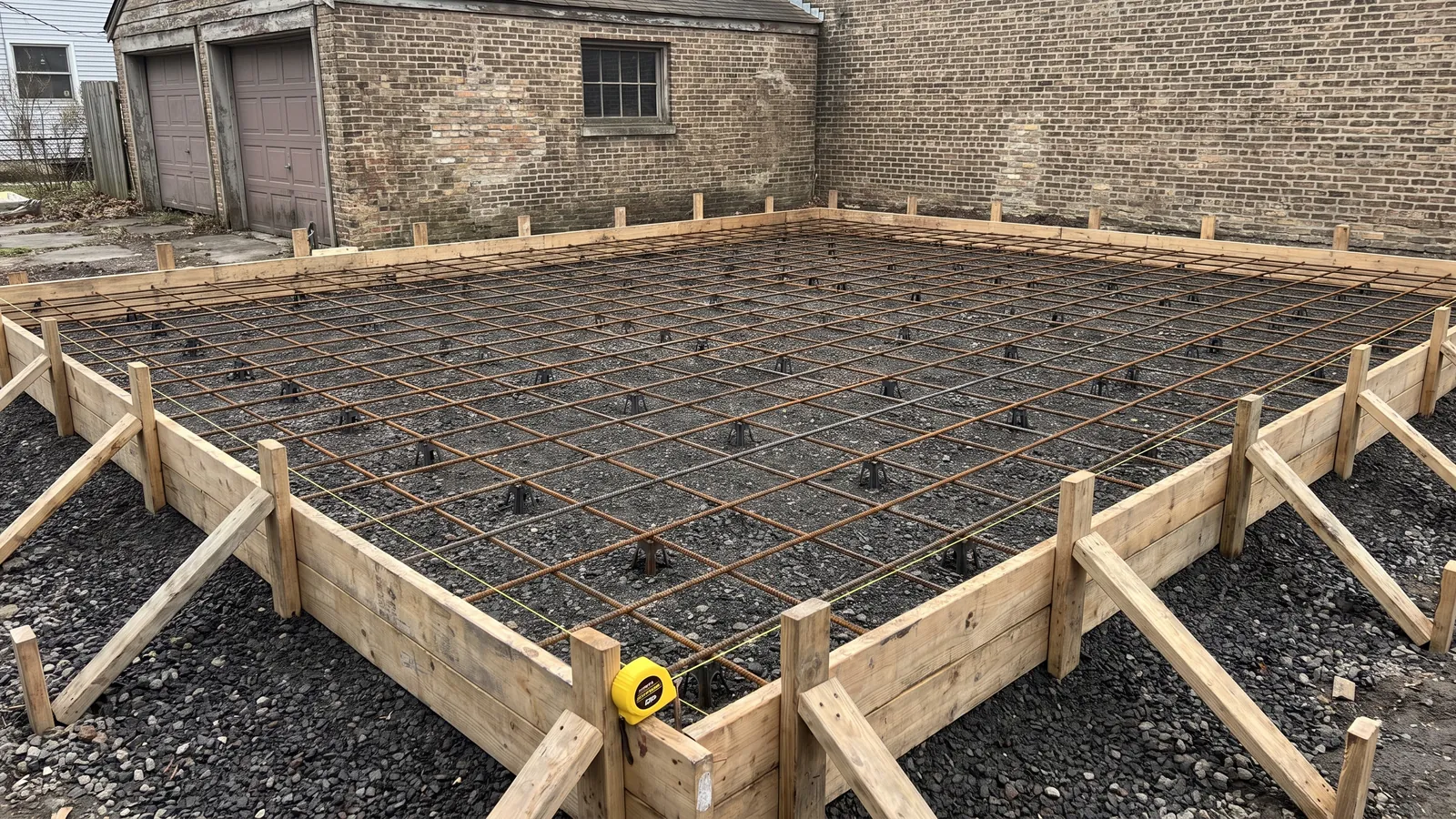
Concrete is ordered by the cubic yard: 27 cubic feet, enough to pour 81 square feet 4 inches thick. Everything else is arithmetic. Enter your slab below, or use the table and the rule of thumb.
Calculator
The formula
Length in feet times width in feet times thickness in feet (inches divided by 12) gives cubic feet. Divide by 27 for cubic yards. Add about 10 percent for waste, uneven base and spillage, and round up to the supplier's increment.
Quick table: cubic yards per 100 square feet
| Thickness | Yards per 100 sq ft | Sq ft per yard | Typical use |
|---|---|---|---|
| 4 inches | 1.23 | 81 | Driveways, patios, walks, shed pads, garage floors |
| 5 inches | 1.54 | 65 | Driveways for trucks and trailers |
| 6 inches | 1.85 | 54 | Workshop floors, heavy equipment pads |
| 7 inches | 2.16 | 46 | Cincinnati driveway aprons (City spec) |
Worked examples
- A 20-by-24-foot garage floor at 4 inches: 480 square feet, 5.9 yards, order 6.5.
- A 12-by-14-foot patio at 4 inches: 168 square feet, 2.1 yards, order 2.5.
- A 4-foot-wide, 30-foot front walk at 4 inches: 120 square feet, 1.5 yards, order 1.75.
- A 15-by-20-foot apron at 7 inches: 300 square feet, 6.5 yards, order 7.
Bags or a truck
An 80-pound bag of mix makes about 0.6 cubic feet; 45 bags make a yard. For an AC pad or a few fence posts, bags. For anything over about half a yard, a truck, because mixing 20 bags by hand produces 20 slightly different batches and a tired person. Ready-mix suppliers have a minimum load and charge for short loads; a short-load or "mini-mix" truck serves jobs of a yard or two.
What a yard costs
Ready-mix is priced per yard delivered, with extras for short loads, waiting time, admixtures (air entrainment, accelerators for cold weather) and Saturday delivery. The material is a fraction of an installed price; the base, forms, reinforcement, labor and finishing are the rest. Our prices are per job with the yardage shown, so you can check the arithmetic against this page.
Questions
How many yards for a two-car driveway?
A 20-by-40 driveway at 4 inches is 800 square feet, about 9.9 yards, so order 11 with waste, plus the apron at 7 inches separately.
What if my slab isn't rectangular?
Break it into rectangles and add them, or measure the area in square feet any way you can and use the yards-per-100-square-feet column.
Why add 10 percent?
The base is never perfectly flat, forms bow a little, some concrete stays in the chute and the wheelbarrow. Running short mid-pour is far worse than having half a yard left over.
How many bags in a yard?
About 45 80-pound bags, or 60 60-pound bags. That's a lot of mixing.
Can the calculator do a thickened edge?
Not directly; add the edge as its own rectangle (length times width times its extra depth) and sum it.
How much does the truck need to reach the forms?
A chute reaches 10 to 15 feet from the truck. Beyond that it's wheelbarrows or a pump, which is a labor and a price question the estimator sorts out.
Get a written price
Tell us the job and where it is. Someone calls back the same day, an estimator measures it in person, and you get a written price with the thickness, the base and the finish spelled out. Nothing is poured on a verbal.