Driveway aprons: the fifteen feet of your driveway that belong to the City
The approach between the sidewalk and the curb has its own permit, its own contractor licence, its own thickness and its own layout rules. Here is what the City requires and how we build to it.
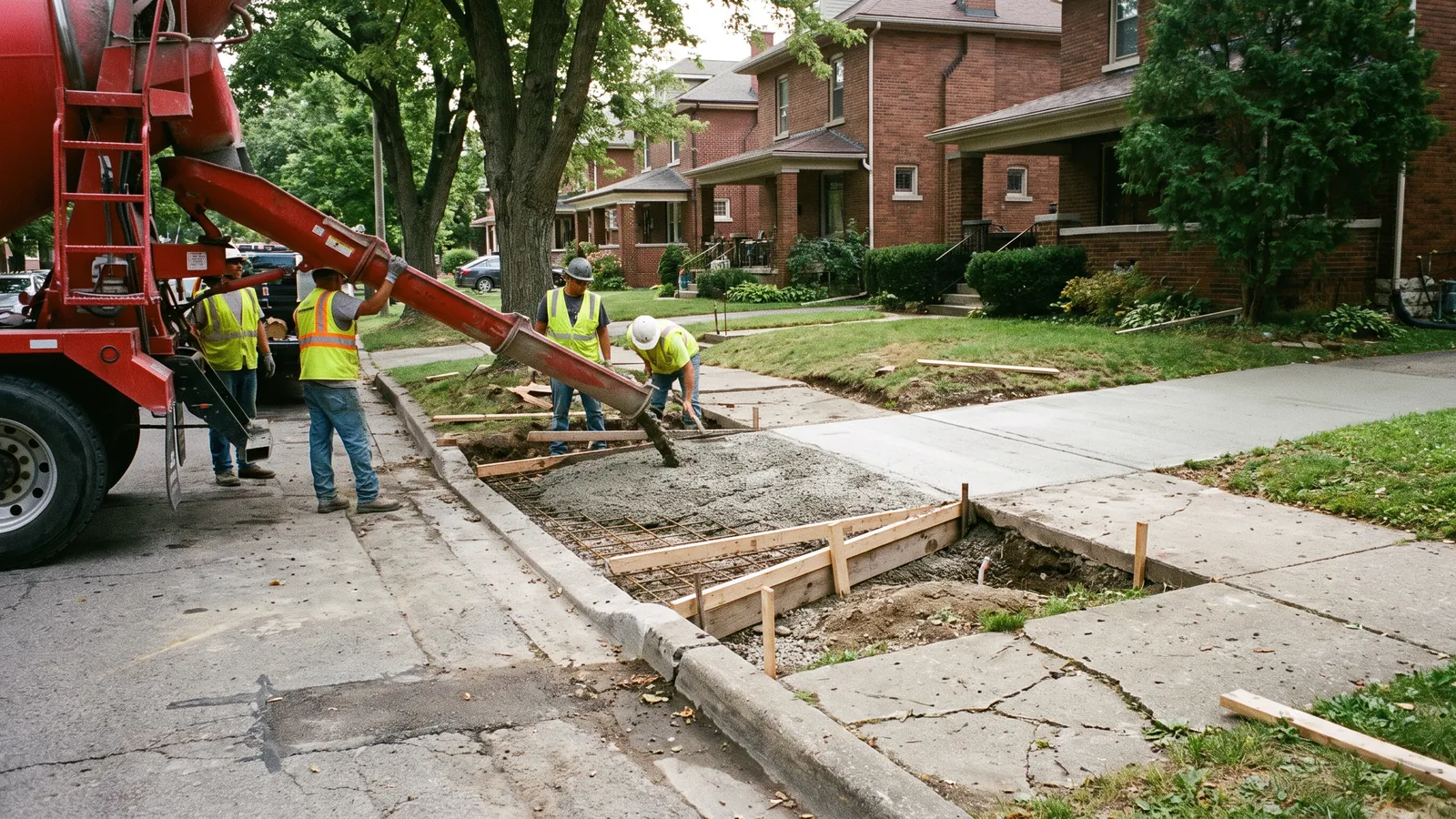
Look at a Cincinnati driveway from the street. The section from the back of the sidewalk to the curb, the apron or approach, is in the public right-of-way. The City of Cincinnati's Department of Transportation and Engineering (DOTE) regulates it as street construction, and the rules are not the same as for the slab on your lot. Most of them are in DOTE's driveway approach permit procedure, which we follow on every job.
The City's rules
- A Street Opening Permit is required to install or modify an approach. It's issued through the Permit and License Center at 801 Plum Street, Suite 425 (513-352-3463).
- A DOTE-licensed street contractor must do the work. DOTE keeps a searchable list of licensed contractors; a new licence takes about ten business days and can't be expedited, so a contractor who isn't on the list today isn't on it next week either.
- Zoning is checked first (Zoning Administration, 513-352-2430), because a driveway's width and position are zoning matters before they're construction matters.
- Utilities are marked through Ohio811 before any digging in the strip, where water, gas and sewer services all cross.
- Concrete spec: minimum 7 inches thick, ODOT Construction and Material Specification 499 Class QC1, 4,000 psi, air-entrained, ready-mixed, with about a 2 percent slope at the sidewalk.
- Layout: no driveway within 50 feet of an intersection; 5 feet clear of hydrants, poles and drains; 10 feet from the center of a street tree; a private driveway at least 8.5 feet wide and at least 10 feet at the property line; a curb opening of 15 to 30 feet for a house (40 for commercial), taking up no more than 60 percent of the frontage.
Why aprons fail and bids go wrong
An apron carries every vehicle that enters the property plus the plows, and it sits at the lowest, wettest, saltiest point of the driveway. Four inches of unreinforced concrete there breaks up within a few winters; that's why the City requires seven in a strong, air-entrained mix. It's also why a driveway bid that doesn't mention the apron is worth a question. Either the contractor plans to pour it to the same 4-inch spec as the rest (and isn't licensed for the right-of-way), or they plan to leave it out and let you discover the gap. Ours lists the apron separately, at the City spec, under the permit, by a licensed street contractor.
What a new apron involves
- Zoning check and permit application. We confirm the width and location are allowed, then apply for the Street Opening Permit.
- Ohio811. Utilities located and marked in the strip, two business days before the dig.
- Saw-cut and removal. The old apron and the curb opening are cut and broken out, the curb reformed to the new opening width.
- Base and forms. Compacted gravel, forms set to the sidewalk and curb grades with the required slope.
- The pour. Seven inches of ODOT Class QC1, 4,000 psi, air-entrained, from a ready-mix supplier, reinforced, broom-finished, jointed.
- Inspection and cure. The City inspects as its permit requires; the apron is protected while it cures and stays closed to traffic for a week.
Cost
An apron is priced on its own line, by its area, at the 7-inch spec with the permit fee passed through. It costs more per square foot than the driveway behind it for obvious reasons: nearly twice the concrete, a stronger mix, the curb work and the permit. The driveway cost page shows where it sits in a whole-driveway price.
Questions about this work
Can I pour my own apron?
Inside Cincinnati, no: DOTE requires a licensed street contractor and a permit for work in the right-of-way. The driveway on your own lot is your business; the apron isn't.
Who pays for the apron, me or the City?
You do, as the property owner, both for a new approach and for repairs to an existing one. The City's permit is what allows the work; it doesn't fund it.
Why is the apron 7 inches when the driveway is 4?
Because it takes the plows, the street traffic turning in, and the worst of the salt and water, and because the City says so. Seven inches of 4,000 psi concrete at the curb is what survives.
How wide can my curb opening be?
15 to 30 feet for a residential driveway, up to 40 for commercial, and never more than 60 percent of the frontage, with the setback rules from intersections, hydrants, poles, drains and trees on top of that.
Does the apron need to match the driveway's finish?
It should be broom-finished for traction. Stamped or exposed-aggregate finishes can be carried across it in some cases, subject to the City's approval of the surface; a plain broom finish is the usual answer.
How long does the permit take?
DOTE's process includes the zoning check and the permit review; we build the timing into the schedule and start the on-lot work while the permit is in hand.
Get a written price
Tell us the job and where it is. Someone calls back the same day, an estimator measures it in person, and you get a written price with the thickness, the base and the finish spelled out. Nothing is poured on a verbal.