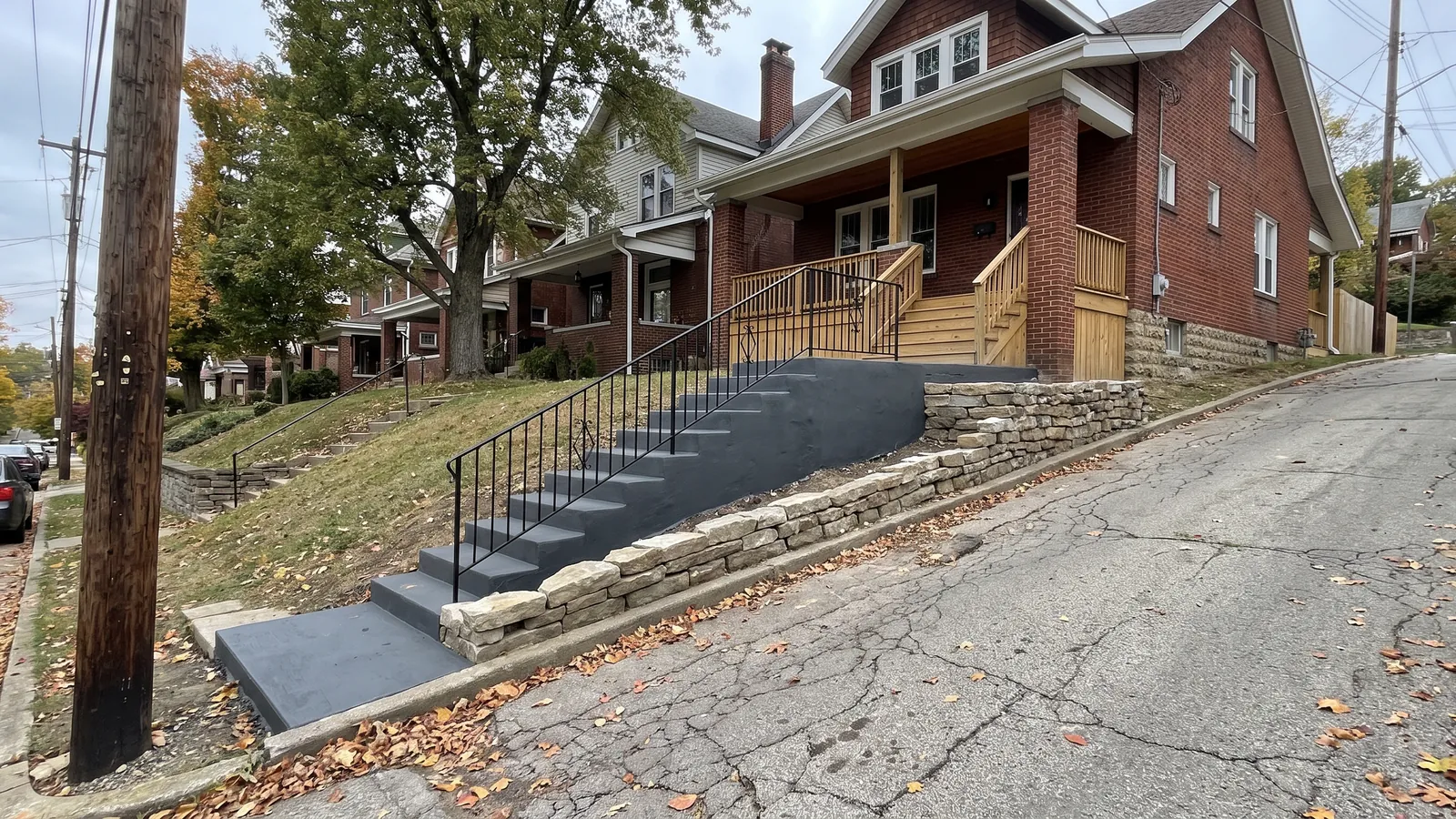
Half the houses on the hillsides are reached by a flight of concrete steps from the sidewalk, and most of those steps are older than the people climbing them. They crumble at the nosings from salt, they tilt when the footing heaves, and the rails loosen when the concrete around them breaks. This page covers new poured steps and stoops, replacing a failed set, and the repairs that make sense on a set that's basically sound.
New steps and stoops
- Footing below frost. The Residential Code of Ohio puts the frost line at 30 inches, and steps that aren't founded below it heave every winter and settle every spring until they lean. Our steps sit on footings dug to depth, which is most of the labor and most of the reason good steps cost what they do.
- Even risers. Every riser the same height, within a fraction of an inch, and treads deep enough for a whole foot. Uneven steps are where people fall, and the building code has rules on riser height, tread depth and rails for a reason.
- Pitch. Each tread pitched slightly forward so water runs off instead of freezing into a glaze.
- Reinforcement and air. Rebar through the mass, and an air-entrained mix because steps are the most salted concrete on the property.
- Rails. Sleeves cast into the concrete for handrail posts, set with the rail maker's spacing, so the rail is anchored in solid concrete rather than drilled into it later.
- Stoops and landings. A stoop is a small slab at the door with steps off it; it needs the same footing, an isolation joint at the house, and a landing deep enough to open the door and stand.
Replacing a failed set
Old steps are demolished, the footing dug to frost depth, forms built riser by riser, and the new flight poured in one placement so there's no cold joint for water to get into. On a hillside flight from the sidewalk, the work is in the City's right-of-way for the lower part and needs the same permit and licensed contractor as a sidewalk; we sort out where the line falls.
Repair and resurfacing
A set of steps with a sound mass and crumbling surfaces can be resurfaced: the loose material removed, the nosings rebuilt with a polymer-modified repair mortar, the treads overlaid and re-textured. Published 2026 figures put resurfacing at $150 to $500 for a set and poured replacement at $200 to $400 per step, with removal of the old steps $250 to $500 (HomeGuide, Feb 2026). Repair is worth it when the steps are level, the footing is holding and the damage is on the surface. It isn't when the flight has tilted or the risers have broken through; then it's replacement, and we'll say so.
Questions about this work
Why are my old steps leaning?
The footing wasn't below the frost line, or there wasn't one. Water under the steps freezes, lifts them, thaws, drops them, and after enough winters they tilt. Steps on a proper 30-inch footing don't.
Can you pour steps against the house?
Yes, with an isolation joint between the stoop and the foundation, and never tied into the house wall; the house and the steps move differently.
How many steps need a rail?
Under the residential code, flights of four or more risers generally need a handrail, and we cast sleeves for it. Your building department has the exact rule for your situation.
Can you match my neighbor's steps?
Riser heights and tread depths follow the code, not the neighbor's. The finish, color and rail style we can match.
Are precast steps cheaper?
Precast units are cheaper per step and go in fast, but they sit on a pad rather than a footing and can shift. Published figures: precast $70 to $110 per step versus poured $200 to $400 (HomeGuide). For a short stoop precast is fine; for a hillside flight, poured.
How long until I can use the new steps?
Two days for careful foot traffic, a week before you'd want to drag anything up them, and no salt the first winter.
Get a written price
Tell us the job and where it is. Someone calls back the same day, an estimator measures it in person, and you get a written price with the thickness, the base and the finish spelled out. Nothing is poured on a verbal.