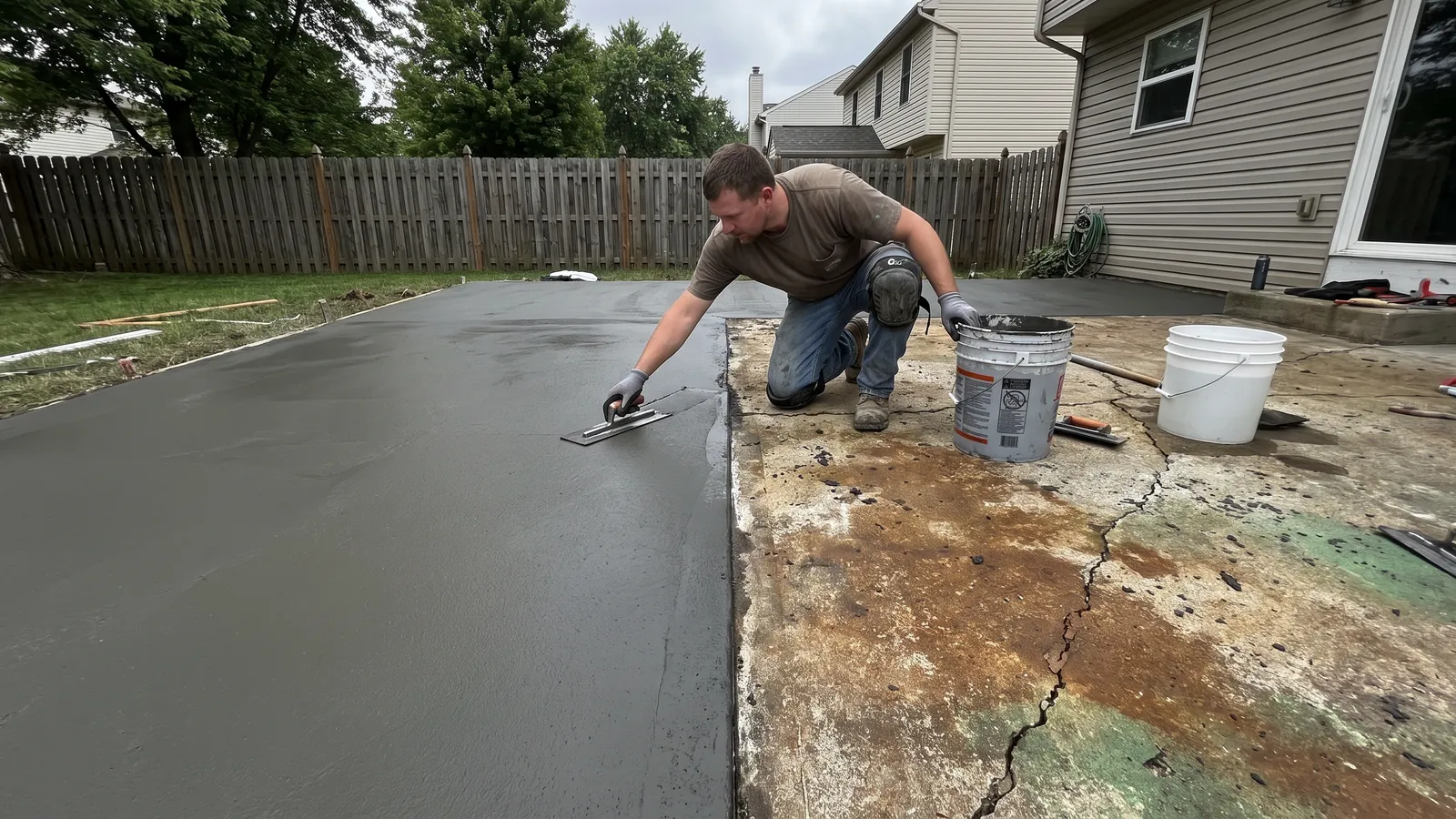
Resurfacing bonds a thin layer of polymer-modified cement, typically a quarter to half an inch, to an existing slab. It can be left plain, broomed, textured, colored or stamped. On the right slab it looks like new concrete for a fraction of the cost of replacement and lasts many years. On the wrong slab it peels, cracks where the old concrete cracks, and lasts a season. The honest part of this page is the second paragraph.
Which slabs can be resurfaced
- Level or close to it. An overlay doesn't fix a sunken panel; that's leveling first.
- Solid underneath. Tap it with a hammer; a hollow sound means delamination and the overlay has nothing to bond to.
- Uncracked or hairline-cracked. A crack in the old slab comes through the overlay unless it's treated and the joint is honored. Big moving cracks aren't overlay candidates.
- Not spalling badly. Light surface flaking can be ground off and overlaid. A slab flaking everywhere has no air in its mix and will keep flaking under the overlay.
- Dry. Moisture coming up through the slab lifts an overlay off. A basement floor or a slab over a wet area needs a moisture test first.
The prep, which is most of the job
The surface is cleaned, then ground or shot-blasted to open the pores and remove sealers, paint, oil and weak material. Cracks are routed and filled. Spalled areas are patched. Joints are taped so they can be re-cut through the overlay. A bonding primer goes down. Only then does the overlay get mixed and applied, in a thin coat for a broom or textured finish or a thicker one for stamping. It cures, the joints are re-cut, and it's sealed. Skip any of that and the overlay is the thing that fails next.
Finishes
- Broom or trowel. A plain gray or tinted surface that looks like new concrete.
- Knock-down or spray texture. A textured, cooler-underfoot surface popular on pool decks.
- Stamped overlay. A thicker overlay stamped and colored like new stamped concrete, the way to get a stamped patio out of an old plain one.
- Stained. Color applied over the cured overlay.
Cost
Published 2026 figures: plain overlay $3 to $7 per square foot, stamped overlay $7 to $20; a two-car driveway $1,200 to $2,900, a one-car driveway $850 to $1,500, a three-car driveway $2,600 to $4,300, a 10-by-10 patio $300 to $700; steps resurfaced $150 to $500 (HomeGuide, Feb 2026). Prep is the variable: a slab that needs a lot of grinding and patching costs more to overlay than a clean one.
Questions about this work
How long does a resurfaced driveway last?
On a sound slab with proper prep, many years, with re-sealing every few years. On a slab that's failing underneath, one or two winters.
Can you resurface over cracks?
Hairline cracks, yes, after routing and filling. Cracks that move with the seasons come back through the overlay; those slabs are leveling or replacement candidates.
Will the overlay peel?
Not if the surface was ground, primed and dry, and the slab is sound. Peeling overlays almost always come from skipped prep or moisture from below.
Can a stamped overlay go over my old patio?
Yes, if the patio is level and solid. It's the usual way to get a stamped look without a new slab.
Can I resurface my garage floor?
Yes, and it's common. Oil has to come out of the surface first, which is part of the prep.
Is resurfacing the same as sealing?
No. A sealer is a thin protective coat; an overlay is a new wearing surface. A sound, good-looking slab needs only a sealer.
Get a written price
Tell us the job and where it is. Someone calls back the same day, an estimator measures it in person, and you get a written price with the thickness, the base and the finish spelled out. Nothing is poured on a verbal.