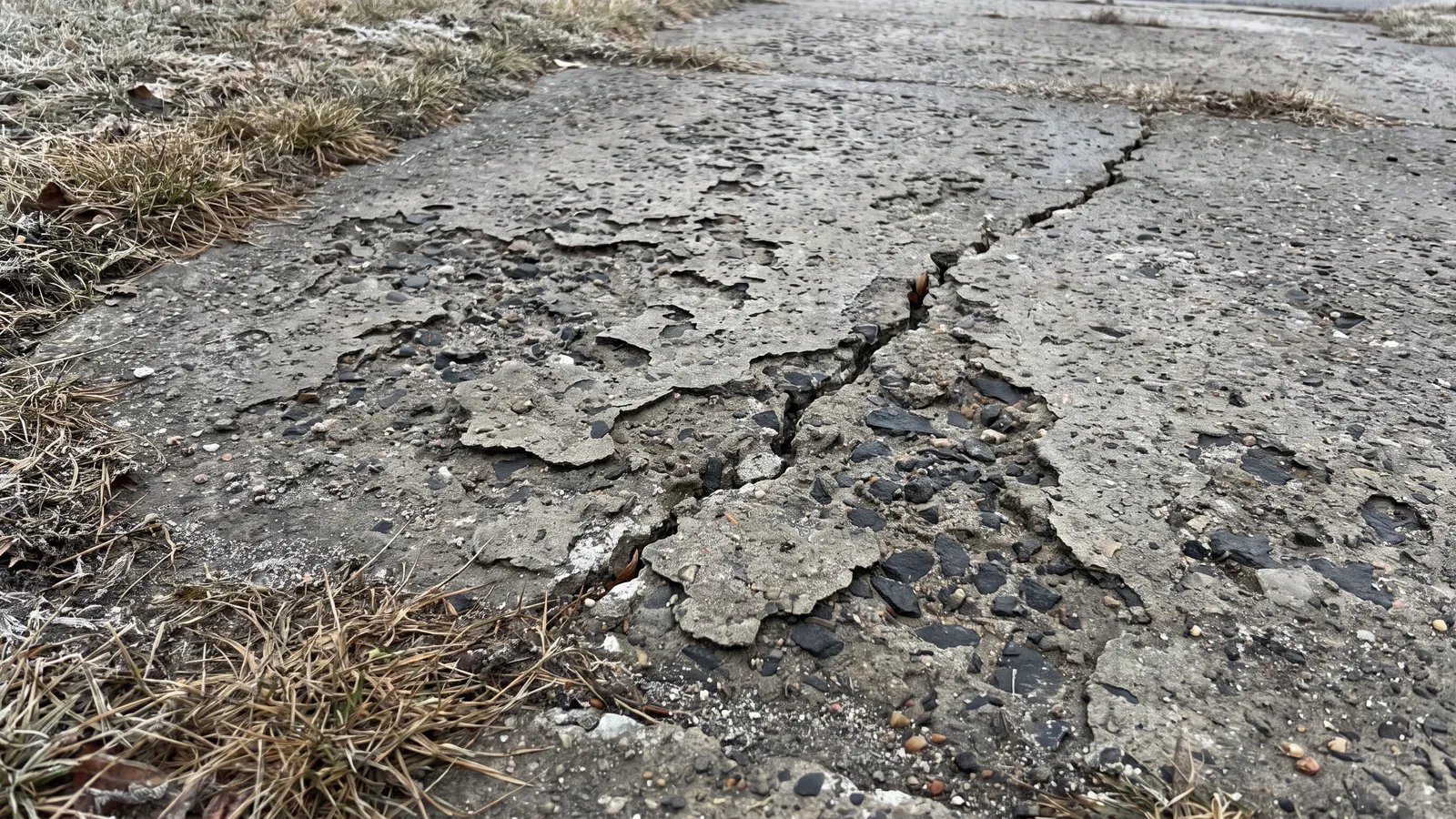
Concrete repair covers everything from filling a crack to replacing a panel, and the honest part of the trade is knowing which to recommend. A patch on a driveway that's flaking everywhere lasts a winter. A new panel in a sidewalk that's otherwise fine is money well spent. Here are the failures we see most in Cincinnati, what causes them, and what actually fixes them.
The failures, and the fixes
| What you see | Cause | What fixes it |
|---|---|---|
| Flaking, pitting, a top layer peeling off (spalling) | Freeze-thaw on a mix without air entrainment, usually with salt | Light: grind and overlay. Widespread: replace the slab; patches won't hold |
| A straight crack between joints that aren't there | Shrinkage with no control joint to guide it | Route and seal; it's cosmetic unless the sides are at different heights |
| A crack with one side higher than the other | The base washed out or heaved under one side | Lift the low side with foam, or replace the panel; fix the water |
| A panel sunk below its neighbors | Settlement of the base, often from a downspout or a trench | Foam or mud leveling; see the leveling page |
| A panel heaved by a tree root | Root growth under the slab | Replace the panel with root pruning where allowed, or grind a small lip |
| Broken step nosings, crumbling edges | Salt and freeze-thaw at the most exposed point | Rebuild with polymer repair mortar if the mass is sound; otherwise replace |
| Joints opened up, weeds, crumbling edges at the joint | Old joint filler gone, water getting in | Clean, backer rod and a flexible joint sealant |
| Surface dusting, stains, a tired look on sound concrete | Age, no sealer, oil and leaf stains | Clean, resurface with an overlay, seal |
Patch, overlay, lift or replace
- Patch. Repair mortar in a broken corner, a step nosing or a pothole-sized spall. Works where the surrounding concrete is sound and the patch can be keyed in. Doesn't work as a general treatment for a spalling surface; the patch stays and the concrete around it keeps flaking.
- Overlay. A thin bonded layer over a sound but ugly slab, plain or stamped. Works on a slab that's level, uncracked or hairline-cracked, and solid underneath. The resurfacing page covers it.
- Lift. Foam or mud pumped under a sunken slab to raise it. Works when the slab is intact and only the base has dropped. The leveling page.
- Replace. Cut out and pour new. Works for everything, costs the most, and is the only honest answer for a slab that's spalling everywhere, broken into pieces, or heaving every winter.
What an estimator looks at
How much of the surface has failed, not just the worst spot. Whether the slab is one piece or several. Whether the panels are level with each other. Where the water goes in a storm and where the downspouts dump. Whether a tree is involved. Whether the concrete has air in it, which an old flaking surface answers by itself. From that, a recommendation that may be smaller than you expected (grind a lip, seal the joints) or bigger (the driveway is done; here's what a new one costs).
Cost
Published 2026 figures: concrete repair at $3 to $8 per square foot, slab replacement $6 to $15 per square foot, foam lifting $8 to $25 per square foot and mudjacking $4 to $9 (HomeGuide, Feb 2026 and Nov 2025 pages). A repair bid from us lists the method and the area, and where replacement is the right answer it says so with the replacement price beside it.
Questions about this work
Can a spalling driveway be saved?
If the flaking is in a few spots and the rest is sound, grind and overlay can buy years. If it's flaking across most of the surface, the mix has no air and it will keep going; replacement is the honest answer.
Is a crack in my driveway a problem?
A hairline crack with both sides level is cosmetic; seal it to keep water out. A crack with a step across it, or one that's growing, means the base has moved and deserves a look.
Will a patch match the color?
Not at first. Repair mortar and new concrete are lighter than weathered concrete and darken over a year or two. On a visible surface we'll tell you what to expect.
Can you fix just one panel of my driveway?
Yes, cut at the joints and replaced, if the panels around it are sound. If the whole driveway is failing, one new panel in it is money toward a replacement instead.
Why does my concrete keep cracking after repair?
Because the cause wasn't fixed: water under the slab, a tree root, or a missing joint. The repair treats the symptom; the estimate has to find the cause.
Do you repair garage floors and basement floors?
Yes. Cracks and spalls are repaired the same way; a floor that's heaving or dusting badly may be better overlaid or replaced.
Get a written price
Tell us the job and where it is. Someone calls back the same day, an estimator measures it in person, and you get a written price with the thickness, the base and the finish spelled out. Nothing is poured on a verbal.