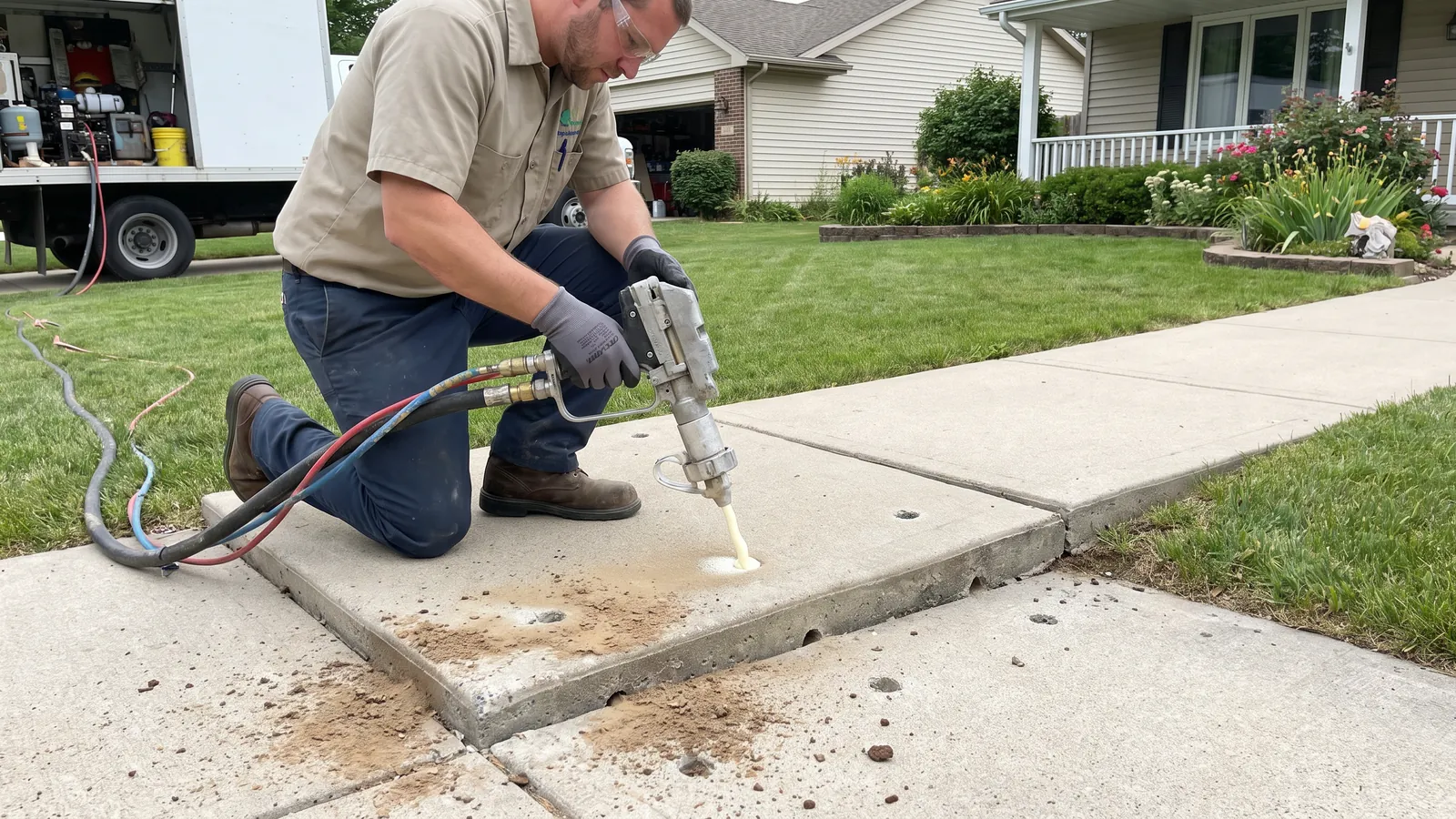
Slabs sink because the ground under them does: a trench backfilled loosely, a downspout washing out the base, clay that shrank in a dry summer, a sidewalk panel next to a tree that drank the moisture out of the soil. If the slab itself is still in one piece, replacing it is wasteful; the concrete is fine, it's just low. Leveling pumps material under the slab through small holes, raises it back to grade, and fills the void so it stays. Two materials do the job.
Polyurethane foam
Two-part foam injected through holes about the size of a dime, expanding under the slab to lift it. Light, so it doesn't add weight to soft ground; cures in minutes, so the slab is usable the same day; fills voids completely; and the holes are small. The usual choice for sidewalks, steps, patios and driveway panels. Published 2026 figures: $8 to $25 per square foot, a 100-square-foot sidewalk $800 to $2,500, a partial driveway of 200 square feet $1,600 to $5,000 (HomeGuide, Nov 2025 page).
Mudjacking
A slurry of sand, cement and soil pumped through larger holes to lift the slab. Cheaper per square foot and heavier, which is good for a slab that needs mass under it and bad for soft ground that's already sinking. Longer cure, bigger patches. Published 2026 figures: $4 to $9 per square foot, a 100-square-foot sidewalk $400 to $900, a full 450-square-foot driveway $1,800 to $4,100 (HomeGuide). Not every crew offers it; we'll say which the job and our crew will use.
What can be lifted
- Sidewalk panels sunk at a joint, including City-notice panels where the City accepts lifting as the repair.
- Front steps and stoops that have settled away from the house (if the mass is sound).
- Driveway slabs sunk near the garage or the street, and garage floors that have dropped.
- Patios and pool decks that have settled on one side.
- Basement and interior floors, with the right access.
What can't
A slab broken into several pieces (it lifts unevenly and the pieces separate). A slab that's spalling or crumbling (it's not worth lifting). A slab that's heaved up rather than sunk (that's a root or frost, not a void). A slab over a known sinkhole, a collapsing drain or a sewer lateral that's failing; the void keeps coming back until the cause is fixed, and lifting is a waste until then. The estimator will say which you have.
What the job looks like
- Survey. The low points are measured against the neighboring slabs, the cause is identified, and holes are planned.
- Drill. A pattern of small holes through the slab.
- Inject. Foam or slurry pumped in stages while the slab is watched with a level, until it meets grade.
- Patch. Holes filled with a matching mortar.
- Fix the water. The downspout extended, the joint sealed, the grade corrected, so the void doesn't return.
Questions about this work
How long does foam lifting last?
The foam itself doesn't break down. The slab stays up as long as the cause of the sinking is fixed; if water keeps washing out the base, it'll sink again around the foam.
Can you lift a slab that's cracked?
A slab in two or three large pieces can sometimes be lifted piece by piece. One in many pieces can't; it's replaced.
How soon can I use it?
Foam: within a few hours. Mudjacking: usually the next day.
Will the holes show?
Dime-sized holes patched with mortar, visible up close for a year or so until they weather in. Mudjacking holes are bigger.
Is leveling cheaper than replacement?
Usually by a wide margin for a sound slab: published figures put foam at $8 to $25 per square foot and replacement at $6 to $15, but a sidewalk panel lift is a one-hour job with no demolition, no haul-off, no cure time and no permit fee for forms.
Can you level a sunken step?
If the steps are one solid mass that has settled, yes, from under the bottom step. If they've broken apart, no.
Get a written price
Tell us the job and where it is. Someone calls back the same day, an estimator measures it in person, and you get a written price with the thickness, the base and the finish spelled out. Nothing is poured on a verbal.